As President Trump’s top legislative priority heads to a (potential) conclusion, we explored how the legislation is playing on social media inside the Beltway, and beyond. Enjoy!
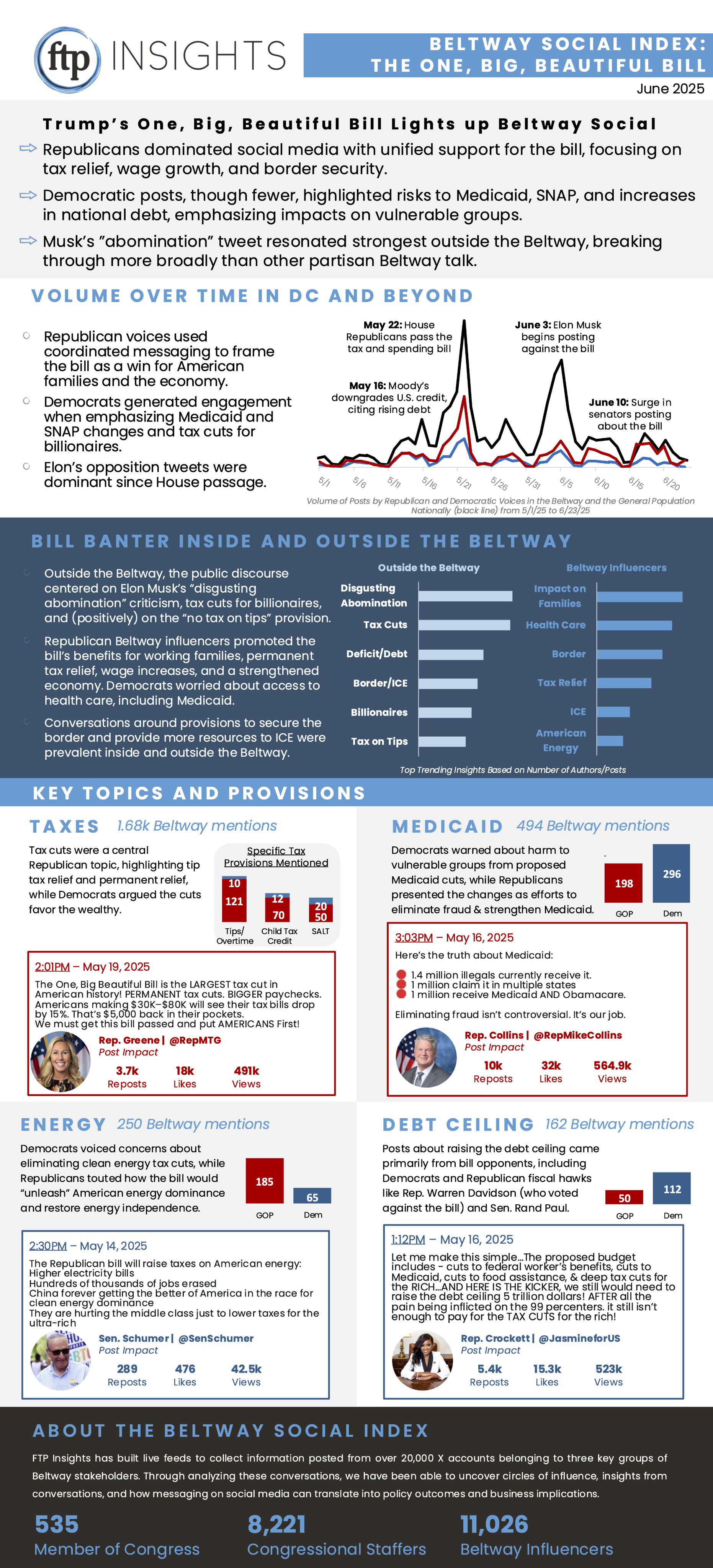
As a reminder, we’ve collected social handles for all Members of Congress and their staffs, key executive branch personnel, NGO leaders, and other influencers and boldface names from around the Beltway. Using natural language processing tools, AI interfaces, and some elbow grease, we’ve analyzed the people, topics, and trends that are dominating the social conversation in Washington.
Our index is a summary of those conversations, plus a comparison with the broader national conversation. You’ll get a sense of where Washington is and where it’s going — and when the conversation inside the Beltway is completely out of touch with the country as a whole.
If you’re interested in learning more about how to put this tool to work for your organization or company, please contact me directly at dusher@forbes-tate.com. And we’d love your feedback as well!
For this edition, we’ve taken a close look at the social conversation over the past year around tariffs — including what topics were most discussed and shared, which members controlled the conversation, and how the tariff debate is trending. Please enjoy!


As a reminder, we’ve collected social handles for all Members of Congress and their staffs, key executive branch personnel, NGO leaders, and other influencers and boldface names from around the Beltway. Using natural language processing tools, AI interfaces, and some elbow grease, we’ve analyzed the people, topics, and trends that are dominating the social conversation in Washington.
Our index is a summary of those conversations, plus a comparison with the broader national conversation. You’ll get a sense of where Washington is and where it’s going — and when the conversation inside the Beltway is completely out of touch with the country as a whole.
If you’re interested in learning more about how to put this tool to work for your organization or company, please contact me directly at dusher@forbes-tate.com. And we’d love your feedback as well!
As the GOP candidates head to Iowa and the election cycle shifts into gear, we wanted to share FTP’s collective thoughts about what will drive the political environment in this critical year.
We hope you find these thought provoking and a bit different from the typical “election deck” — not just who’s up and who’s down but the things to keep in mind and guide your thinking as the election takes shape.
As always, please reach out with any thoughts or questions you might have.
About Forbes Tate Partners:
Forbes Tate Partners is a bipartisan, full-service public affairs consultancy specializing in government relations, grassroots advocacy, strategic communications, fundraising, and business development. The firm’s primary areas of specialty are the development and implementation of bipartisan lobbying and advocacy strategies related to tax, health care, natural resource management, trade, energy, telecommunications, outdoor recreation, appropriations, and agriculture. Jeff Forbes and Dan Tate, Jr. founded the firm in 2012.

| Welcome back to FTP Insights’ Beltway Social Index — with a focus on China. For this month, we’ve taken a close look at the social conversation over the past year around China — including what topics were most discussed and shared, which members controlled the conversation, and how it the China debate is trending as we head toward the 2024 election. Please enjoy! As a reminder, we’ve collected social handles for all Members of Congress and their staffs, key executive branch personnel, NGO leaders, and other influencers and boldface names from around the Beltway. Using natural language processing tools, AI interfaces, and some elbow grease, we’ve analyzed the people, topics, and trends that are dominating the social conversation in Washington. Our index is a summary of those conversations, plus a comparison with the broader national conversation. You’ll get a sense of where Washington is and where it’s going — and when the conversation inside the Beltway is completely out of touch with the country as a whole. If you’re interested in learning more about how to put this tool to work for your organization or company, please contact me directly at dusher@forbes-tate.com. And we’d love your feedback as well! |

Welcome to the inaugural edition of FTP Insights’ Beltway Social Index.
We’ve collected social handles for all Members of Congress and their staffs, key executive branch personnel, NGO leaders, and other influencers and boldface names from around the Beltway. Using natural language processing tools, AI interfaces, and some elbow grease, we’ve analyzed the people, topics, and trends dominating Washington’s social conversation.
Our monthly index summarizes those conversations, plus a comparison with the broader national conversation. You’ll get a sense of where Washington is and where it’s going — and when the conversation inside the Beltway is entirely out of touch with the country as a whole.
If you want to learn more about putting this tool to work for your organization or company, please contact me at dusher@forbes-tate.com. And we’d love your feedback as well!
In advance of the 2022 mid-term elections, the FTP Insights team, along with Senior Vice President Trevor Hanger, who has decades of strategic investment and political experience, investigated the American electorate’s opinion of the current state of the economy. These are the topline findings:
- Over the past 12 years, American have held a near non-stop negative outlook on the economy – ranging from a 94 percent “not so good/poor” viewing of the economy at the height of the Great Recession to a 70 percent “not so good/poor” rating today, based on rising inflation and consumer prices.
- Voters have turned away from every political leader in the country – disliking both parties and the leaders who represent them.
- The constant change and see-sawing in US politics and the economy is filtering through the electorate: the last five presidents beginning their presidency with unified control to push for large, dramatic political change. This dramatic swing has never happened before.
- The “whipsaw” – political, personal, and economic change – is driving the problem into 2022. However, these trends may tell a larger (problematic) story for both parties moving forward.
To read more on the Winter of American Discontent, click here.
As schools across the country near the end of their first full semester back, it is easy to forget the public debate over the return to in-person learning that occurred at the beginning of the year. The return to classrooms was a dominant topic within the broader COVID-19 recovery discussion and encompassed a variety of subthemes, ranging from the debate over mandates and public safety to union influence and curriculum reform.
The FTP Insights team conducted a full analysis of Twitter conversations and traditional media coverage from January 1 to October 2, 2021. We looked through over 6,550 individual news stories and 12.2 million tweets in search of major themes in coverage, as well as the changes in volume.
The debate over mask and vaccine mandates in schools drove the bulk of the conversation in the second half of the year, spiking volume that was otherwise subsiding as the summer arrived and there was agreement to return to classrooms.
Throughout the summer conversation, coverage surrounding the return to in-person learning began to lull. Volume jumped again on July 9 following the CDC announcement recommending mask requirements for students returning to school in the fall. The rise of the Delta variant only served to boost the topic further.

The social media conversation was dominated by key stories about children bringing COVID-19 back into their homes and passing it to parents, accompanied by opinions and debates over concern for students and families. There were also debates over the mask mandate bans implemented by governors such as Texas’ Greg Abbott and Florida’s Ron DeSantis.

Partisan divides emerged in the Beltway not on the decision to return to in-person learning, but on the specific safety protocols surrounding that return.
Aside from mask mandates, Republicans argued in favor of the benefits both to students and parents of returning to in-person learning, mostly highlighting the return to “normalcy” and the economic benefits of having parents who would otherwise be supervising their children return to the office. Democrats, on the other hand, focused on the Delta variant and voiced concerns over how it may spread quickly among schoolchildren, and advocated for more robust safety policies in classrooms.

The evolution of teachers unions’ hesitancy about returning to in-person learning strongly influenced the themes in coverage during the spring; less so after they came out in support of returning to classrooms.
As parents and local governments pushed for school re-openings in the spring, influential teachers’ unions were hesitant to return to classrooms, citing health concerns among their members despite being prioritized for vaccination. One of the most high-profile cases of this reluctancy among educators occurred in Chicago, where the city’s union threatened to strike in early February after the local government announced in-person learning would resume. San Francisco also gained volume in social media conversation when the city government sued its own school district after reopening plans were delayed.

Critical Race Theory (CRT) was central to coverage among Beltway publications, with a strong focus on the influence of teacher unions on curriculums
CRT surfaced as a subtheme within the broader school reopening discussion among traditional media sources. Notably, CRT was more central to the discussion among these publications, whereas they were more of an afterthought among major outlets outside Washington, D.C., such as The Wall Street Journal or the New York Times (see below). Interestingly, there was no meaningful conversation tying Critical Race Theory to school re-openings in our Twitter analysis.

Now that the CDC has authorized the use of COVID-19 vaccines for school-age children and talks of potential vaccine mandates for eligible students — which already exist in colleges — have surfaced, the FTP Insights team is keeping a close eye on how the broader in-person narrative evolves into the spring. Understanding the underlying issues within the opposition to mask mandates will be crucial as the country navigates the policies of the next phase in the fight against COVID-19.
This report was compiled through contributions from Caitlin Gallagher, Ethan Quan, and Santiago Olea. FTP is proud to provide ongoing research, trends, and expert opinion and insights to provide our clients with high level resources. You can reach our insights team for access to our full analysis: CGallagher@forbes-tate.com.
The Virginia gubernatorial election between the former Carlyle CEO Glenn Youngkin and the former Democratic governor Terry McAuliffe was one of the most high-profile elections of the 2021 cycle. On November 2nd, the former won the Governor’s Mansion by over two points in a state that President Biden had won by 10 points just a year earlier, culminating the most expensive election in the state’s history — over $115 million in combined fundraising.
Our team conducted an analysis of the Twitter conversation from June 1 to November 6, 2021, in search of the underlying themes and messages of both campaigns. We analyzed close to 6.2 million tweets mentioning the candidates or terms surrounding the election and identified a nationalized race that was strongly defined by education-related issues.
The second debate was a significant turning point in the race, shifting focus from a broader set of issues to a race focused on public education.

The early campaigns were local by nature, driven by kitchen table issues mostly focused on mask and vaccine mandates, reproductive health, and voting rights. More specifically, both vaccine mandates and abortion accounted for most spikes in conversation during the summer and were central to the first gubernatorial debate on September 16.
Two weeks later, the race leapt onto the national stage following the second gubernatorial debate on September 28, where Terry McAuliffe claimed, “I don’t think parents should be telling schools what they should teach.” The Youngkin campaign capitalized on the Democratic candidate’s comments and pivoted its main messaging to one stressing the importance of parental input on their children’s education.
The Republican candidate’s campaign tailored broader education-related policy issues to specific voter subsets, accompanied by crafted messaging around Critical Race Theory and the Loudon County public school system’s alleged failure to address a case of sexual assault. Following the second debate in late September, the volume of conversation around both campaigns spiked dramatically, with education emerging as the single most popular policy issue.

Beyond education, which was the dominant policy issue within the conversations surrounding both candidates, the Youngkin campaign focused on tax cuts while the McAuliffe campaign prioritized strengthening the economy through job creation.
Youngkin’s campaign drove an out-sized education-focused campaign in the latter half of the election cycle, as evidenced in the volume of conversation surrounding his campaign mentioning the policy area compared to that of the McAuliffe campaign. The latter, which made the decision to maintain the candidate’s claim against parental control in classrooms, was forced to react to Youngkin’s messaging, albeit to a lesser extent.

Aside from broader education issues and COVID-19, the economy was also central to the election as the candidates debated how to foster long-term economic growth. Youngkin’s campaign streamlined its messaging around making Virginia more business- and consumer-friendly, starting with the elimination of the grocery tax and the suspension of the recently increased gasoline tax. McAuliffe, on the other hand, drew on his success in creating jobs during his first term as governor to signal his ability to continue to do so.
Our analysis shows a clear focus on education as the leading issue, and continued acceleration of conversation following the key turning point in the Sep 28 debate. While other issues played a role, education issues defined the race as it entered the national stage.
FTP is proud to provide ongoing research, trends, and expert opinion and insights to provide our clients with high level resources. You can reach our insights team for access to our full analysis: CGallagher@forbes-tate.com.
Forbes Tate Partners (FTP) recently hosted a virtual conversation featuring policy and insights experts and the Bipartisan Policy Center’s Chief Medical Advisor, Anand Parekh. The discussion focused on the COVID-19 conversation on social media, policy trends in the states, and the federal response to the current pandemic and how policymakers are preparing the nation for future challenges. The panelists included Barrett Thornhill, Partner; Caitlin Gallagher, Senior Director; Kristina Dunklin, Senior Vice President; and Francesca McCrary, Senior Vice President.
Media Environment: A New Normal
As America dealt with the reality of COVID-19 and was awaiting the development of a vaccine in mid-2020, narratives around the pandemic were pervasive in major media outlets. This was especially true at the New York Times, where the issue accounted for 57 percent of all its stories. This level of focus continued into 2021, where COVID-19 was mentioned in 58 percent of the stories in the outlet over the same duration of time. Early trends within media coverage at the height of the pandemic showed cohesive narratives focused on a small pool of topics. Nearing the end of 2021, these narratives have extended and shifted into a more fragmented environment. This dispersion means a multitude of topics to discuss, and there are a wider variety of entry points to deliver your message to your audience in existing narratives.

Social media conversation has largely followed similar trend lines, but focused volume on COVID-19 has fallen significantly since the beginning of the pandemic. There was a significant spike in social media conversations focusing on the pandemic in spring of 2020 and again when news broke that President Trump tested positive. Since then, focus has shifted to more specific narratives around the future of the workplace and the return to in person learning that often go without mentioning COVID-19 by name.

Conversation among Beltway leaders tends to follow the party leading the executive branch. Republicans had a strong hold on conversation in 2020, but patterns shifted as the election drew near and Democrats gained traction moving into 2021. Since then, conversation has been dominated by rollout of policies and mandates.
Lastly, understanding how the divide in the conversation has shaken out is also important. Republicans were leading the conversation last year, and that dynamic flipped a month out from the election and has been sustained since then.

State Policy Landscape
The fourth substantial COVID “wave” is in the rear-view mirror, but the pandemic seas are still rolling. Waning natural immunity and vaccinal immunity (along with the confusing advance of boosters), more time inside as the weather gets colder, and the relaxation of public sentiments as the school year advances could lead us back into the deep. However, the nation might be better prepared now with vaccines being approved for children between the ages of 5-11, strong testing supplies, a strong supply of monoclonal antibody treatments, and a new resource via oral antivirals within site. Although most states saw a peak in cases a month ago, a few are still mired in high cases loads – and then there is Florida, with the lowest case load in the nation. Looking ahead, there is a greater need for direct and local responses in states. Eventually, federal support will dwindle; preparedness in terms of testing supplies, therapeutic treatments and continuous vaccinations and boosters is key for states when responding to the pandemic.

The Federal Response
Nearly two years after the COVID-19 outbreak, trillions of dollars have been spent on short-term relief and aid. Republicans and Democrats are tackling this issue from different perspectives. First and foremost, the response has been focused on returning the country to normalcy as quickly as possible – getting the economy back on track, ensuring people can return to work and kids get back in the classroom.
Looking ahead Republicans are focusing on four key issues to stabilize American life and return to normalcy as quickly and efficiently as possible, as well as the need to understand the origins of COVID-19 as a way to better prepare for future pandemics.
Of particular note is Republicans’ support for the Pandemic and All Hazard Preparedness Act (PAHPA). Last authorized in 2019, this historically bipartisan effort will need to be reauthorized by September 30, 2023. Improving the supply chain industry and ensuring the U.S. has manufacturing powers and capabilities to face whatever economic hardships come our way is essential. Lastly, improving the overall general health and wellness of the American public is key to protecting lives moving forward. The federal government will need to address gaps in healthcare for low-income populations and individuals in rural areas, increase access to telehealth services, and improve access to mental health services.
Meanwhile, Democrats seemed to be focused on addressing the vast health disparities that already exist in this country but were magnified by the pandemic. Specifically, lawmakers have a newfound desire to address care to lower income communities, seniors, and health deserts that desperately need access to healthcare during a pandemic.
Democrats are motivated to invest in rural healthcare and increasing funding for telehealth services, so care can be provided to vulnerable populations. Returning to normalcy in a strategic way that supports everyday workers and families and ensures resources are in place for employees and their families to access the vaccine are a priority. Similarly to Republicans, Democrats continue to invest in mental health services and provide support and resources to address the opioid epidemic.
FTP is proud to provide ongoing research, trends, and expert opinion and insights to provide our clients with high level resources, especially as they navigate a COVID-19 environment. You can reach our panelists at: CGallagher@forbes-tate.com, BThornhill@forbes-tate.com, KDunklin@forbes-tate.com, and FMccrary@forbes-tate.com.
As Americans go back to work after more than a year of layoffs and remote work, our team examined the conversation on Twitter around employment and its connection to traditional media coverage of the topic. We analyzed over 1.6 million Twitter posts and 16,000 news stories since January 2020. Through our analysis, we discovered changing narratives, important areas of focus, and critical moments in the conversation and coverage.
To download the full report, click here.
Overview

March 2020 marked the peak of employment conversation on Twitter, which remained high but changed in tone throughout the pandemic.
We saw a significant increase in the volume of conversation about employment following nationwide closures at the start of the pandemic. Volume stayed above pre-pandemic levels through 2020 and into 2021, however the tone of conversation on social media shifted. When the pandemic began, conversation among everyday Americans was playful and lighthearted. Working from home was new and stay-at-home orders were believed to be temporary. As the shutdown continued, posts became increasingly serious.
Peaks in traditional media coverage of employment were caused by major events, with unemployment at the heart of coverage.
Like conversation on social media, coverage of employment increased significantly when the pandemic hit the U.S.. Traditional media covered the evolving situation, as non-essential businesses shut down and Americans shifted to remote work. Unemployment also became a major focus of traditional media outlets, with news stories educating readers about relevant topics like the stimulus bill and its unemployment benefits.
Volume of coverage declined after the summer but spiked again after another major event: President Biden taking office. Minimum wage became a major focus due to debates in Congress over the American Rescue Plan. At the same time, unemployment continued to be at the center of coverage. However, focus notably shifted from providing unemployment benefits to ending them.
The COVID Era:
News stories about unemployment dominated the traditional media landscape, with consistently high engagement from the public.

Traditional media created a new interest in the changing nature of the workplace on social media.
The pandemic also sparked an interest in the changing nature of the workplace. Americans who were still employed wondered how the pandemic would impact their jobs. Would remote work become the new normal? Would the workday shorten? We found that the topic was first covered by traditional media outlets soon after stay-at-home orders began in early March. This coverage set up the conversation for everyday Americans, which began on social media a week later. Following these peaks in March 2020, traditional media coverage of the topic fluctuated, while the conversation on social media was more consistent. A year later, adaptive work environments are now becoming the norm. Industry giants like Amazon and Kickstarter have announced remote work flexibilities and four-day work week experiments, while nations like Spain and Iceland advocate for changes to the workplace.

On social media, Beltway Insiders used the pandemic as an opportunity to push policy.
For Beltway Insiders, the pandemic marked a unique opportunity to push policy agendas. Compared to everyday Americans, the employment conversation among Beltway Insiders fluctuated regularly. During peaks in volume, their posts focused on what the government should or should not do in response to the changing state of employment. Posts from Democrats drew the highest engagement, often focusing on workers’ rights, income disparities, and employment benefits.
The Post-COVID Era:
Amidst fears of a labor shortage, the conversation around unemployment benefits has become negative.
We found that a second perspective on unemployment emerged in 2021, with unemployment benefits now seen as a threat to recovery. As the country’s priority has shifted toward returning to work, a Hill-HarrisX poll found that voters now blame unemployment benefits for keeping unemployed Americans from searching for jobs. 71% of voters think unemployment benefits are at least part of the reason unemployed Americans are not returning to work. That number rises among Republicans; 84% of whom say unemployment benefits are a problem.

In actuality, reasons like lack of available jobs or concerns about COVID have played a larger role in people’s decision to not return to work. A survey by the U.S. Chamber of Commerce found only 16% of unemployed Americans have enough money from unemployment benefits that they do not want to look for work.
Nonetheless, this misconception has been a large part of the employment conversation, especially as concerns of a labor shortage have grown. Social media has indicated there is a different reason why companies are failing to hire people: wages and working conditions. Rather than blame unemployment benefits, everyday Americans are calling for companies to step up.

Traditional media narratives about employment are shifting focus.
We found that a distinct and separate conversation about minimum wage emerged in 2021 after Biden took office. This topic first moved toward the forefront of coverage when Congress negotiated the American Rescue Plan, leading to a partisan debate over raising minimum wage to $15 which Beltway media outlets followed intensely. At the same time, there was also narrative around minimum wage emerging outside of Congress, as massive companies like Walmart and Costco independently increased their wages to $15 per hour or more. With Congress ultimately removing minimum wage from the stimulus plan, this topic is likely to be an increasing area of interest for traditional media outlets, especially as unemployment becomes less relevant.
After initially coming together to fight unemployment during the pandemic, we also found that the left and right have returned to their pre-pandemic ways, focusing on the issues most important to their audiences. While unemployment has continued to be an area of interest for the left and right, coverage from right leaning outlets like Breitbart and The Washington Examiner has shifted toward ending unemployment benefits and getting Americans back to work. In contrast, coverage from left leaning outlets like Vox and Salon has increasingly focused on minimum wage and getting protections and benefits for workers. These more partisan news stories draw high engagement from readers, indicating that the divergence between coverage from the left and right will likely continue post-pandemic.
Contradicting opinions have emerged from conversations about UBI and other regular payments from the government.
The pandemic caused many Americans to require assistance from the government, allowing Beltway Insiders to reintroduce conversations regarding UBI, either mentioning it by name or mentioning something like relief checks that appeared to be a very similar concept. We found that Beltway Insiders – especially Democrats — were far more active in the conversation about checks to voters and other concepts like UBI, but rarely discussed UBI by name. This difference was even larger among Republicans.
Interestingly, we saw evidence that this difference also appears in public opinion. A Monmouth poll found 81% of voters supported a stimulus check, and Data for Progress found 56% support extending the Child Tax Credit permanently. However, despite majority support for these regular government payments, only 45% of Americans support UBI according to Pew Research.
The topic of career transitions has gained momentum on social media as the world enters a post-pandemic workplace.
With many Americans experiencing stalls in their careers during the pandemic due to fewer promotions, stagnant salaries, etc., we found that a distinct conversation regarding career transitions developed on social media. For Americans who were dissatisfied with their careers, disruptions caused by COVID were an opportunity to make radical career moves. As a result, the conversation around career transitions spiked among everyday Americans during the start of the pandemic, when work suddenly changed for millions of people. However, since 2021, the conversation has gained momentum once more, as the workplace shifts toward a post-pandemic era.
FTP’s Joshua Britt and Hannah Ritz also contributed to this report.