Contributions to this blog were made by Jeff Sadosky, Lauren Crawford Shaver, Sabrina Siddiqui, Jeanne Moran, Kate Jahries, Erin Van Gessel, and Britton Burdick
In a recent FTP note, we looked at the parallels between the 2008 financial crisis and today’s COVID-19 pandemic – both in terms of the massive government recovery efforts and the corresponding crisis messaging. Not only are there parallels, there are key learnings that communicators and corporate leaders need to consider as they work their way through the pandemic.
However, the landscape of 2008 is not the world of 2020. There have been significant changes over the last 12 years between the financial crisis and today, including how the American people access information, from whom they get that news, and advertising practices. For example:
- In 2008, 21% of U.S. adults were using social media compared to 72% in 2020; and
- Today, there are 77 million Instagram users on a platform that did not exist in 2008; and
- In 2008, $22.66 billion was spent on global digital advertising dollars and in 2020, that number reached over $333 billion – a 1,470.65% increase.

There are many additional, foundational differences between now and the 2008 financial crisis. No one should dust off the same playbook from 2008, though there are lessons to be learned, with many of the same regulators and policymakers jumping back into the fray to fight this fire. The massive shift in information consumption and means of communications, though, should help formulate any advocacy or crisis communications planning moving forward.
Forbes Tate Partners (FTP) was recently named a top-performing lobbying firm in Washington, D.C. by Bloomberg Government for 2019 – marking the fourth year in a row that FTP has achieved this distinction. The list reviewed lobbying activity over the past year by more than 2,000 lobbying firms.
“Our success stems directly from our deep team of government relations and public affairs experts who create outcome-driven strategies and build effective campaigns for our clients,” said FTP Founding Partner Dan Tate, Jr. “This is a unique time of uncertainty, when understanding the next steps Congress and the administration could take is paramount for companies large and small from every industry. We value the trust our clients place in us to help them in this trying time.”
The full Bloomberg Government report is available to download here.
###
About Forbes Tate Partners:
Forbes Tate Partners is a bipartisan, full-service public affairs consultancy specializing in government relations, grassroots advocacy, strategic communications, fundraising, and business development. The firm’s primary areas of specialty are the development and implementation of bipartisan lobbying and advocacy strategies related to tax, health care, natural resource management, trade, energy, telecommunications, outdoor recreation, appropriations, and agriculture. Jeff Forbes and Dan Tate, Jr. founded the firm in 2012.
With Congress passing the “CARES Act” and heading back to the states, focus has turned to the governors taking outsized roles leading and coordinating the response to the COVID-19 pandemic. Across the political spectrum, those who are demonstrating leadership and transparency, and effectively managing their state’s bureaucracy and emergency response teams, are reaping the political benefits, as evidenced by the infographic below, which comes from our FTP Insights team.

Currently, the U.S. has 140,904 cases of the novel coronavirus, COVID-19. There are 32 states with stay at home orders. Last week, unemployment filings topped three million, the largest number recorded in history. Everyone is racing to cushion the economic fallout and stem the bleeding. The Federal Reserve has pulled nearly every lever available to it, Congress is moving on to its fourth, and likely not last, stimulus measure, and private sector companies have stepped up in a manner reminiscent of war times.
While in many ways what we are facing is completely unprecedented, and our public health response and pandemic preparedness planning will fundamentally change forever, there are many components of what’s happening that are parallel to the 2008 financial crisis. For companies that are preparing to partake in much needed stimulus money, here are three lessons on optics to remember from 2008. These are not financial or business lessons but, rather, reminders on perception and politics.
1. Nuance is easily lost when the figures are trillions with a “t.” As a former Treasury spokesperson under Secretary Geithner, I can attest to the countless stories and news cycles that were based on the headline, and not the facts. It’s easy to play politics with a caricature, with nuance and nitty gritty pieces of policy and regulation falling by the wayside. We’re already seeing this creep into reporting, with CEOs being accused of selling stock to profit off COVID-19, when in reality, the plans to sell said stock were put in place, and in writing, well before the World Health Organization (WHO) declared a pandemic. For companies that take stimulus money, it would behoove them to spend time charting out the implications and political perceptions that will create click-bait. This type of scenario planning should be plotted out years in advance. To some extent, there will always be political hits that are taken, but the 2008 financial crisis showcased the pitfalls of easily preventable mistakes.
2. Information moves even faster now. In 2008, Twitter had one million users. Today, there are nearly 60 million. The 2008 crisis was before fake news, Russian bots, and dubious Facebook groups. So take lesson number 1, and multiply by 1,000. In many ways, this presents an opportunity. We’re already seeing private sector companies and foundations share news, solutions, and ideas for how to help their employees and the country weather this storm via social media. Conversely, this also means that misinformation travels faster. To that end, content is key. Communicate your message, your perspective, and your value add to society directly, cleanly, and often. While social media has displaced local news in many ways, it has also cut out the middleman. Craft your story, show the human side of it, and share your message broadly. People are hungry for good news and someone to root for – you should make sure it’s you.
3. Alphabet soup is stewing, so prepare accordingly. The 2008 financial crisis yielded a set of new agencies. FSOC. SIGTARP. CFPB. At this time, the $500 billion in assistance for businesses will be administered by the Treasury Department, with oversight from a yet to be formed Inspector General. For all companies who take funds, this means preparing for audits, Congressional hearings, and new reporting requirements. But the official requirements, as we’ve seen, are only part of that calculus, with traditional media and social media further complicating these debates. For those who prepare and plan on these asks from the beginning, oversight should be a welcome chance to showcase good governance of funds and value add to communities.
The parallels to the financial crisis of 2008 aren’t exact. Lives will be lost, and many businesses and families are facing disruption on a scale never before seen, for reasons that are beyond any control. But there are still lessons to be learned and planning to be done – and serious pitfalls that can be avoided with a thoughtful, holistic approach.
COVID-19 has had profound impacts on all sectors of the economy, and cannabis is no exception. In states where cannabis regulatory systems exist, we are seeing for the first time how the cannabis economy responds to economic turmoil and national crisis. There are three trends to watch: Demand, supply, and access.
Demand
Many were surprised to see that COVID-19 has not hampered the demand for cannabis. Though it will take a few months of data to confirm this as a trend, word from the industry is that cannabis sales have remained steady this past month, with many citing a surge in sales as consumers stocked up before sheltering-in-place. California saw a 159% year-over-year increase in sales on the day San Francisco ordered residents to shelter-in-place.
We are also unfortunately going to see how the cannabis economy holds up in a recession. Most of us have speculated that cannabis will behave like alcohol during periods of recession. That is, we expect to see consumers continuing to budget for cannabis purchases, and no significant decline in wholesale activity. That said, alcohol also shows us that a continued recession will likely change the kinds of products that cannabis consumers purchase. They will likely move away from expensive brands in search of bargain deals. Interestingly, this will be the first time during a recession that we will have data on the types, quantity, and concentration of cannabis purchased, thanks in large part to companies like Metrc. Very preliminary data has shown some movement towards edibles – California and Washington State both saw a ~30% increase in edible sales for March compared to the previous months. This data over the next few months will tell us what products (flower, concentrates, edibles, tinctures, etc.) consumers view as providing the greatest value for the dollar.
The continued, or even increased, demand for cannabis during COVID-19 is a bright spot for the industry in what has otherwise been an 18-month period where market growth failed to meet expectations.
Supply
Unfortunately for the industry, they appear less able to capitalize on this demand than other industries would be. These state regulated systems are more fragile to the whims of the economy and workforce than companies that have national distribution. We have already seen store fronts have to close down as they struggle to supply product. Many of the larger growers and manufacturers appear able to adapt their operations, at least in the short term, to meet new sanitizing and social distancing requirements. Smaller operations may struggle to meet challenging new logistics. And since cannabis supply chains must remain intrastate, many states may see supply issues in the coming months. It remains an open question how well the industry as a whole will be able to maintain supply, and at what cost.
Watch the wholesale price of cannabis by state in the next few months. A spike in price may indicate a less mature state cannabis industry, which in turn means future industry growth.
Access
While the industry may struggle with supply chains, their ability to be labeled “essential” for purposes of public access is a clear display of the power industry, consumers, and advocates have gained at the local level. Last decade, state and local officials couldn’t talk about cannabis legalization without making a stoner reference. Now, cities and states across the country have declared cannabis an essential part of their society, giving them the privilege of staying open while the restaurant and hair salon nearby have to shutter. Denver Mayor Michael Hancock told Denver residents they would have to shelter-in-place without access to dispensaries, before quickly backtracking on that decision a few hours later. In states like Massachusetts, where Governor Baker has only allowed medical cannabis licensees to stay open, powerful grassroot organizations have already started to mobilize to get adult-use licensees classified as essential as well.
COVID-19 has even pushed state and local governments to embrace home delivery. Oregon just passed emergency rules allowing for retail stores to engage in delivery services. In San Francisco, delivery giant Eaze suspended operations for one day at the direction of the Department of Public Health, only to have that ban lifted later that same day.
These movements make clear that the right for consumers and patients to access cannabis has reached a societal tipping point, at least in states with legalization. Future regulatory efforts will have to contemplate how to provide continued access to cannabis in all environmental conditions.
Legalization efforts
In states that have not legalized cannabis, the COVID-19 response will stall legalization efforts that appeared on course to pass – states like New York and Connecticut have understandably sidelined legislation while they deal with more immediate concerns.
Post COVID-19, when legalization efforts restart, there will be renewed emphasis on the cannabis industry’s ability to create employment. Cannabis is unique in that, for the foreseeable future, it requires massive amounts of manual labor to bring it to market (growers, taggers, trimmers, transporters, budtenders, and ancillary services like electricians and plumbing). Also, because the cannabis industry has to order many of its inputs within its own state, the cannabis industry has an unusually high state-GDP and state-employment multiplier. A 2016 study of Colorado’s industry by the Marijuana Policy Group estimated this multiplier to be about 2.4, ranking it top amongst non-governmental industries. Within the year, this economic argument will gain new traction as states like New York, Connecticut, and Florida consider adult-use legalization during economic recovery.
Additionally, if there does end up being a supply challenge, these same advocates are going to be closely monitoring any negative public health effects from illicit market activity, especially as it pertains to cannabis patients. Remember, this is the same illicit market that was largely responsible for the vaping crisis a few months back. Expect to see credible arguments in the future that COVID-19 exposed the need for better state systems and perhaps even federal cannabis policies to ensure a safe, consistent buying experience for consumers and patients in good times as well as times of crisis.
Closing thoughts
The COVID-19 crisis is the first national stress test for legalized cannabis, both as a movement and as an industry. Initial indications on all fronts is that cannabis legalization is remarkably resilient. On the supply side, where it is most weak, it will only grow stronger as the industry matures. This resilience is welcomed news for advocates and the industry, but it should also serve as a wake-up call for public health and government officials. Though the federal government has been slow to act, legal cannabis is now a permanent fixture in much of America and will continue to spread with time. Officials must increasingly recognize that we should be spending our efforts contemplating the best ways to provide legal access to cannabis while maintaining public health and protecting public safety.
We will continue to keep you updated on interesting developments in the cannabis world. There will be a lot to discuss around how COVID-19 will impact cannabis venture funds, the economics of hemp and CBD, as well as the federal future of cannabis.
As America continues to take action to slow the spread of the coronavirus and Congress works through its next steps on COVID-19 response, a new debate is beginning over the health and economic tradeoffs of prevention measures like social distancing and business closures. President Trump kickstarted the debate with his comment that, “I would love to have the country opened and up and just raring to go by Easter.”
He’s not the only one with an opinion. Business leaders, medical experts, influencers, and elected officials are all beginning to weigh in. But there are divisions even within specialties. On the public health front, voices like Dr. Zeke Emanuel have noted that, “People are not going to go to Disney World if they die or get coronavirus…no matter how open the economy is,” while others like Dr. John Ioannidis have argued that “…locking down the world with potentially tremendous social and financial consequences may be totally irrational.” Business and thought leaders are also divided, with Apple’s Tim Cook and Amazon’s Jeff Bezos touting their efforts to close stores, support employees, and have their companies play a constructive role, and New York Times columnist Thomas Friedman arguing for an approach that balances health and safety, while James Freeman of the Wall Street Journal questions business closings in the wake of nearly 3.3 million new jobless claims. On the political front, governors from both sides of the aisle have reiterated the importance of response measures, while Texas Lt. Governor Dan Patrick suggested that grandparents wouldn’t want to sacrifice their grandchildren’s economic future just for their own survival.
Below you can see where selected thought leaders stand on the COVID-19 risk versus growth continuum.

*With credit to Kahla Haber-Brown for graphics.
While there is still a bit of work left to do on the third piece of the federal response/stimulus to COVID-19, with action expected in the House, many are looking to what’s next while at the same time clearly understanding what has been done to date. To that end, FTP’s research and graphics team has put together this infographic to help answer those questions.

With COVID-19 cases in every state, the severity of its impact and responses by the states vary. Putting politics aside, let’s take a look at what actions have been taken, why, and what may be working for other states to follow. We have broken down state actions into three buckets:
- Access to health care coverage
- Social distancing measures
- Testing
Access to Health Care Coverage
Ensuring easy and affordable access to health care is vitally important during a public health crisis such as this. With actions taken by insurers to alleviate the costs of testing and follow up action by Congress, all group health plans and individual health insurance coverage will cover testing and visits related to COVID-19.
To make sure people have coverage, states are taking action to expand access during this pandemic.
COVID-19 Care Coverage
Many states are using their authority and new federal flexibility to take action to bolster their health insurance systems and provide coverage specifically related to COVID-19. For example:
- Two states (Massachusetts and New Mexico) and the District of Columbia, have waived any patient cost sharing for COVID-19 treatment.
- Six states (Kentucky, Louisiana, Maine, New Hampshire, Pennsylvania, and Rhode Island) have waived prior authorization requirement for COVID-19 testing.
- And looking to the future, nine states (Kentucky, Louisiana, Maine, Maryland, Massachusetts, Nebraska, New York, Oregon, and Rhode Island) and the District of Columbia have taken action to provide free access to a COVID-19 vaccine when it becomes available.
Health Insurance Coverage
When it comes to coverage through Medicaid, Medicare, and the Children’s Health Insurance Program (CHIP), states are taking action. Thirteen states (Alabama, Arizona, California, Florida, Illinois, Louisiana, Mississippi, New Hampshire, New Jersey, New Mexico, North Carolina, Virginia, and Washington) have now received rapid approval from CMS on federal Section 1135 waivers. These waivers provide states with additional flexibility to make sure patients are enrolled in coverage, and health care facilities are able to provide necessary care during a national emergency.
Additionally, ten states are taking action to expand access to insurance coverage by opening Special Enrollment Periods (SEPs) specific to COVID-19. This will allow residents of those states to enroll in health insurance coverage through state-based health insurance marketplaces for any reason.
Further, as unemployment increases, individuals can enroll in coverage in any state due to either the loss of employment or their existing insurance – even if the state or federal exchange is not offering a special enrollment period.
| State Exchange | Enrollment Period Ends |
| Colorado | April 3 |
| Connecticut | April 2 |
| Maryland | April 15 |
| Massachusetts | April 25 |
| Minnesota | April 21 |
| Nevada | April 15 |
| New York | April 15 |
| Rhode Island | April 15 |
| Washington | April 8 |
| Vermont | April 17 |
*Note: California and the District of Columbia are allowing resident to enroll now for reasons not initially related to the pandemic.
States are also looking to increase bandwidth in, and therefore access to, their health care systems through regulatory flexibility, including Texas’s recent actions to bring more nurses into the system and Idaho’s removal of 125 regulations to allow for out of state and retired medical professionals to be brought to bear during crisis. Bottom line, during this crisis, there are options for coverage.
Social Distancing Measures
States have taken action to limit the movement and spread of COVID-19 within their communities. These efforts, known as “social distancing” vary in extent, severity, and enforcement mechanisms from state to state.
Typically, these restrictions start with the closure of schools and reduction in the size of public gatherings and progress to statewide orders to close non-essential businesses, and finally orders for residents to stay at home except for certain essential activities:
- Closing schools: Forty-six states, American Samoa, the District of Columbia, Guam, Northern Mariana Islands, Puerto Rico, and the Virgin Islands have closed schools while they remain open in four states.
- Closing “non-essential” businesses: Eleven (California, Connecticut, Delaware, Illinois, Indiana, Maryland, Massachusetts, Michigan, New York, Ohio, and Pennsylvania) states have closed all “non-essential” businesses.
- “Stay at home” orders: Twelve states (California, Connecticut, Delaware, Illinois, Indiana, Louisiana, Michigan, New Jersey, New York, Ohio, and West Virginia) have issued “stay home” orders, which means all non-essential trips to and from home are barred for a certain period of time. That length of time differs from state to state. Further, Massachusetts and Maryland have made their stay at home guidance voluntary. To put this in the broader national context, over 126 million people (39%) of the population is being officially told to stay home.
Testing
With public health care professionals advising that widespread COVID-19 testing will be an important weapon in fighting the epidemic, the federal government has loosened requirements and allowed states to develop and implement their own testing programs. This has quickly led to a number of states jumping into action.
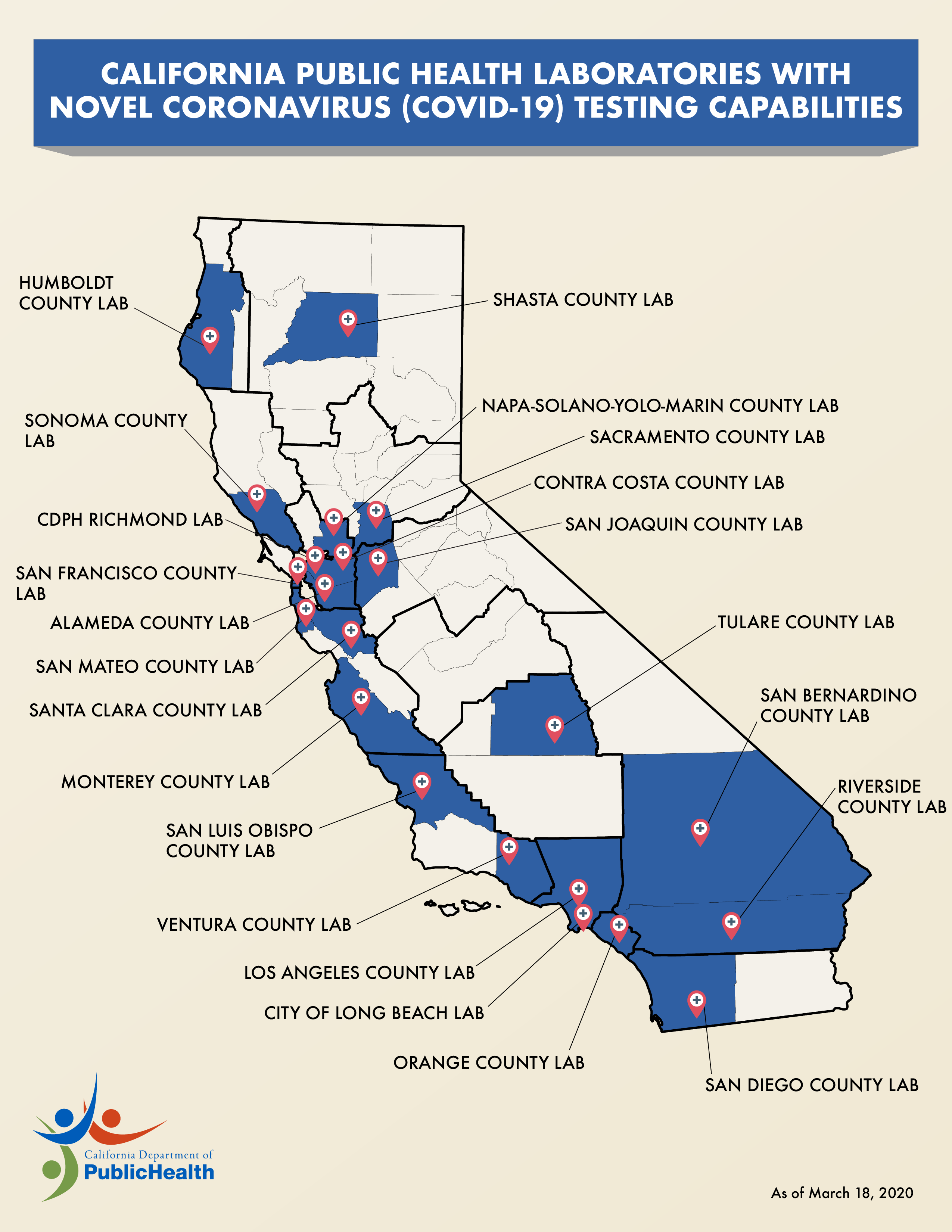
There are currently 22 public health laboratories testing results of COVID-19 tests, which feeds into the California Department of Public Health for daily reports. This stemmed the initial number of cases as universities, labs, and commercial companies were able to help, beginning in early March, and drastically ramp up the amount of tests conducted per day.
New York has ramped up their testing program quickly and is now testing nearly five times the share of its population compared to the United States, as a whole.
Washington has taken a diverse set of resources to ramp up testing that includes: the State Public Health Lab, University of Washington Virology Lab, and commercial labs (Labcorp and Quest). All of these labs and results feed into the Washington Disease Reporting System (WDRS) to analyze data across the state.
It is still too early to measure the impact of health care coverage, social distancing, and/or increased testing. With the actions states have taken, one thing is certain: In the coming days, states who have not yet taken action will learn from those who have. Addressing COVID-19 is not a partisan issue – states like Ohio, Massachusetts, and Maryland have taken measures similar to Illinois, Pennsylvania, and Connecticut. As the states begin to learn best practices, the spread of COVID-19 will be slowed, and Americans will have access to the care they need.
Disclaimer: With all of this information changing rapidly, please check back to our blog for updates. The data and information included here is up to date as of Tuesday, March 24th at 9am EST.
Our founding members Jeffrey Forbes and Dan Tate Jr. sent this note to clients earlier today regarding the latest on DC’s response to COVID19.
Friends,
With the number of COVID-19 cases continuing to surge, national, state and local policymakers are working to address and mitigate the effects of this public health crisis. Forbes Tate Partners (FTP) has put together a short summary of what is happening in Congress, what measures are being taken to stabilize the economy, and a brief preview of future plans.
We will continue to send these updates out on a regular basis.
The Federal Reserve continues to look for ways to provide support to the U.S. economy via monetary stimulus, having already dropped rates to zero, loosened balance sheet requirements for banks, added liquidity to the overnight repo market, and pulled forward $700 billion in asset purchases in Treasuries ($500 billion) and mortgage-backed securities ($200 billion). Yesterday the Fed announced two financial-crisis-era programs to support commercial paper in an effort to unclog the short-term lending market. Even with those steps, the Fed and other leaders look to Congress to facilitate fiscal stimulus.
In an effort to provide a lifeline to businesses and families as a growing number of cities come to a virtual halt in an attempt to flatten the curve, Congress thus far has responded with a first tranche of $8.3 billion to fight COVID-19 directly. This tranche provides federal agencies money for vaccines, tests and potential treatments, and funding to help state and local governments respond to the threat. The second tranche now heads to the President’s desk for signature and guarantees free coronavirus testing, secures paid emergency leave, enhances Unemployment Insurance, strengthens food security initiatives, and increases federal Medicaid funding to states.
We expect a third tranche of stimulus (“Phase 3” or “Stimulus 3”) to support industries hit the hardest, including the travel and hospitality industry. Details are still being negotiated as both parties and the White House work to rapidly address the needs of the American public. At this time, Senate Minority Leader Chuck Schumer and other top Democrats recommend at least a $750 billion package, while President Trump and Senate Republicans have come back with a $1 trillion stimulus proposal, including $500 billion in direct payments to taxpayers, according to a recent Department of Treasury white paper. Any Phase 3 stimulus will include measures to support small to medium-sized businesses. The sheer size and complexity of Phase 3 is likely to require longer negotiations. However, driving the sense of urgency is that fear about the economy is nearly even across party: 86% of Democrats and 84% of Republicans are concerned about the impact on the economy.
At this point, everything is on the table. Members of Congress and the media are comparing this to 9/11 and the Great Recession of 2008, and both responses took months to come together and had many iterations. To that end, as news and updates are changing hourly, FTP will continue to monitor and flag key moments and opportunities for our clients. Additional stimulus measures will be moving over the next few weeks and your client leads will be working closely with you and your teams. While this is an unprecedented time, FTP will be here to work step by step with our clients, as we always have.
Please do not hesitate to reach out with any additional questions and stay healthy and safe.
Jeff Forbes and Dan Tate Jr.
While millions look towards the federal government to respond to the ongoing coronavirus outbreak, state legislatures throughout the country are confronting serious questions about keeping their citizens safe. As states consider emergency supplemental funds, enhanced public health measures, and even whether to officially encourage individuals to fist bump rather than shake hands (Alabama SJR 40), legislators must also get the normal business of the year completed in a shortened election year — all while protecting themselves from contracting COVID-19.
In this unconventional environment, several states have taken extraordinary steps to end legislative sessions early. While four states did not have legislative sessions this year and eight adjourned on schedule (or with slight adjustments for unrelated reasons), below are some of those states taking measures to wrap up activity early over coronavirus concerns. This does not include the many other legislatures which have decided to close public facilities or events to the public to limit exposure.
- Colorado – The General Assembly fast-tracked a proposal to give state parties flexibility to delay assemblies and conventions, which legislators viewed as must-pass before a potential temporary shutdown.
- Connecticut – Lawmakers ended activity early last week to make way for intensive, four-day cleaning. While legislative activity is set to resume this week, lawmakers are already discussing moving up consideration of the state budget in case the virus forces a permanent closure. The legislature also extended some committee deadlines and voted to allow legislators to vote by phone at the committee level.
- Delaware – The Delaware General Assembly postponed legislative sessions for this week, with the expectation that legislators will return March 24 after re-evaluating conditions at that time.
- Georgia – Initially scheduled to adjourn April 3, the Georgia General Assembly indefinitely suspended activity following the adoption of a budget, with 11 legislative days to be made up in the future.
- Illinois – Both chambers of the Illinois General Assembly canceled their sessions for a week, with plans to resume on March 24.
- Kentucky – The state canceled two days of scheduled meetings on Friday and Monday, with the expectation that legislative business will resume on Tuesday.
- Missouri – The Missouri Senate postponed legislative activity through this week, while the House is accelerating budget consideration to facilitate an extended leave.
- Vermont – The Vermont Legislature will adjourn for the entirety of this week with a plan to return on March 24, with the option to extend that date further if necessary.